BRD Diverso
Class RON and Class EUR
Investment fund of diversified (mixed) type.
It invests in several categories of financial instruments (equities, monetary and fixed income instruments, state and corporate bonds).
The protected value of the fund pursued by the administrator, but not guaranteed, represents 90% of the maximum value of the unit net asset registered in the last 12 months prior to the current date. The implementation of the investment strategy known in the literature as the Constant Proportion Portfolio Insurance (CPPI) will take into account the fluctuations of VUAN in the reference currency of the fund. Taking into account that the Fund also issues fund units denominated in both RON and EURO, the level of protection will be different between the two classes, depending on currency fluctuations and the cost of hedging operations.
The fund allows for relatively stable financial performance (the stability offered by fixed income and monetary instruments is combined with the broader dynamics of equity instruments).
The performance of the Fund may be influenced by the negative performance of one or more financial markets in which the Fund invests. In this sense, there is no form of guarantee for the investments made by investors.
Who does it suit?
You can choose this fund if you want to invest in the medium term in a diversified portfolio of Romanian stocks, bonds and monetary instruments but at the same time you want to protect the invested capital by limiting, as much as possible, the potential losses to a maximum of 10%. Given the fund's profile, it is appropriate if you are willing to accept a medium degree of risk. You can invest in this fund in both RON and Euro.
ISIN Fond Class RON: ROFDIN000150
ISIN Fond Class EUR: ROFDIN0002H8
Decizie autorizare ASF: nr.1713/27.08.2008
Registru ASF: CSC06FDIR/400056/27.08.2008
GIIN: YCEN9M.00006.SF.642
LEI: 549300LTSY3CEY2QLU18
Urmărește evoluția Class RON pe Bloomberg*
Urmărește evoluția Class EUR pe Bloomberg*
* Informațiile sunt prelucrate și puse la dispoziție de entitatea-terță Bloomberg, iar BRD Asset Management S.A.I. S.A. nu iși asumă nicio responsabilitate cu privire la conținutul informațiilor furnizate de Bloomberg.
Informațiile și datele prezentate au rolul de a permite clienților și potențialilor clienți ai BRD Asset Management S.A.I. S.A. să ia o decizie de investiții informată. Prin consultarea acestui material, sunteti de acord sa accesați și utilizați aceste date exclusiv în scop investițional.
mediu spre scăzut (Class EUR)
Sustainability Information
Product name: Open-End Investment Fund BRD Diverso
Classification under EU Regulation No. 2088/2019: Article 8
LEI: 549300LTSY3CEY2QLU18
Version 2
Date: 11.05.2026
Information regarding the Open-End Investment Fund BRD Diverso which promotes environmental and social characteristics
The Open-End Investment Fund BRD Diverso (FDI BRD Diverso) is a diversified financial product aiming to achieve favorable returns under favorable conditions in relevant financial markets, while limiting potential losses. The investment fund promotes environmental and social characteristics by building a diversified portfolio through allocating resources in financial instruments (shares, bonds, money market instruments) that have improved environmental, social, and governance (ESG) characteristics at the aggregate portfolio level; however, the fund does not have a sustainable investment objective nor does it aim to have a minimum proportion of sustainable investments. The fund will invest at least 75% in financial instruments aligned with environmental and social characteristics. To support investment decisions, ESG analysis will complement the established evaluation of financial information. For selecting financial instruments (shares, bonds, exchange traded UCITS in the form of ETFs classified as Article 8 funds according to Regulation (EU) 2019/2088 and exchange traded UCITS in the form of ETFs classified as article 9 funds according to Regulation (EU) 2019/2088, and money market instruments), the Fund will use specific ESG methods, such as “positive screening” and “negative screening” and the use of ESG scores from a recognized external data provider (Morningstar - Sustainalytics) to build a portfolio with improved environmental, social, and governance characteristics, aiming to contribute to reducing environmental and social risks.
This financial product promotes environmental or social characteristics but does not have sustainable investments as its objective nor aims to have a minimum proportion of sustainable investments.
The Open-End Investment Fund BRD Diverso aims Fund aims to contribute to reducing environmental and social risks by building a diversified portfolio with improved environmental, social, and governance (ESG) characteristics at the aggregate portfolio level. The fund will invest at least 75% in financial instruments aligned with environmental and social characteristics. To promote environmental and social characteristics by building a portfolio with improved ESG characteristics, the fund will use specific ESG methods:
• Use ESG scores from a reputable external data provider (Morningstar - Sustainalytics).
• Positive screening or exclusionary screening. In cases of investments in financial instruments with similar characteristics (such as industry, sector or geographical exposure, type, liquidity, costs, etc.), the fund will select instruments with superior ESG scores. The fund will not invest in financial instruments with an ESG score above 50 according to Morningstar – Sustainalytics;
• Monitoring the overall ESG risk of the fund and limiting it by maintaining an aggregate average score of financial instruments with improved environmental and social characteristics (equities, bonds, exchange traded UCITS in the form of ETFs classified as Article 8 funds according to Regulation (EU) 2019/2088 and exchange traded UCITS in the form of ETFs classified as article 9 funds according to Regulation (EU) 2019/2088, and money market instruments) of maximum 25. If the aggregate average score of these instruments exceeds 25, the fund portfolio will be rebalanced within a reasonable timeframe and respecting investors’ interests.
The Open-End Investment Fund BRD Diverso aims to achieve favorable returns under favorable conditions in relevant financial markets, while limiting potential losses. Specifically, the Administrator will implement a Constant Proportion Portfolio Insurance (CPPI) strategy. The application of CPPI does not guarantee achieving the protection objective. The Fund’s assets are structured into two segments: (1) The low-risk segment is intended to provide the Fund protection against potential losses that could be generated by the higher-risk segment. This first segment consists of money market instruments and bonds, which present low interest rate and/or credit risk. Assets in this segment will be diversified to reduce portfolio risk. Instruments that can be considered in this category, without limitation, are bank deposits, money market instruments, fixed income instruments, as well as units of funds issued by investment funds that predominantly invest in the aforementioned assets. (2) The higher-risk segment focuses on achieving favorable returns for the Fund. This segment mainly includes shares but also units of funds issued by investment funds exposed to shares or other assets that can generate the sought returns. The Fund will aim that most shares in this segment are listed in Romania.
ESG analysis will complement traditional financial evaluation to support investment decisions. For selecting financial instruments (equities, bonds, exchange traded UCITS in the form of ETFs classified as Article 8 funds according to Regulation (EU) 2019/2088 and exchange traded UCITS in the form of ETFs classified as article 9 funds according to Regulation (EU) 2019/2088, and money market instruments), positive and exclusionary screening will be used to build a portfolio with improved ESG characteristics to reduce ESG risks.
BRD Asset Management pays particular attention to the good governance practices of issuers in which the Fund may invest, considering that sound governance is a prerequisite for creating sustainable long-term value. Good governance is assessed as a preliminary condition for investment eligibility, in line with the requirements of Article 8 of Regulation (EU) 2019/2088 (SFDR) and with the governance standards of the Group to which BRD Asset Management belongs.
The assessment of these practices combines external ESG data sources (such as ESG ratings from Sustainalytics and data provided by Bloomberg) with proprietary qualitative assessments for issuers that do not have sufficient external evaluations (based on Société Générale’s sectoral policies as well as on company disclosures). In such cases, particular attention is paid to remuneration policies, labor relations, and tax compliance—areas considered relevant to the issuer’s long-term stability.
In the case of exchange-traded UCITS in the format of ETFs, the Fund will primarily invest in ETF-type UCITS that qualify as financial products referred to in Articles 8 and 9 of Regulation (EU) 2019/2088, which are required to assess the good governance of the companies in which they invest.
When investing in exchange-traded UCITS in the format of ETFs that do not qualify as financial products under Articles 8 and 9 of Regulation (EU) 2019/2088, investments will be made following an analysis of the issuers included in the ETF’s portfolio, based on the available data regarding its composition.
If significant governance shortcomings are identified, BRD Asset Management may decide to exclude the issuer from the investment universe or to maintain the investment subject to a clear remediation plan.
BRD Asset Management also promotes active engagement with issuers as a tool for improving governance practices.
The Fund’s assets are structured into two segments: (1) The low-risk segment provides protection against potential losses from the higher-risk segment. This segment consists of money market instruments and bonds with low interest rate and/or credit risk. Assets in this segment will be diversified to reduce portfolio risk. Instruments in this category include bank deposits, money market instruments, fixed income instruments, and units of funds investing mainly in these assets. (2) The higher-risk segment is focused on achieving favorable returns and mainly includes shares and units of funds with exposure to shares or other return-generating assets.
The Fund will always maintain 75% of its assets in “Investments aligned with environmental and social characteristics” (“Other environmental and social characteristics”). This category may include shares, bonds, exchange traded UCITS in the form of ETFs classified as Article 8 funds according to Regulation (EU) 2019/2088 and exchange traded UCITS in the form of ETFs classified as article 9 funds according to Regulation (EU) 2019/2088, and money market instruments. The “Other” category, representing a maximum of 25% of total Fund assets, may include financial instruments without an ESG score (such as cash, equities, bonds, UCITS and money market instruments), non-exchange-traded UCITS, UCITS that do not qualify as financial products referred to in Article 8 of Regulation (EU) 2019/2088, UCITS that do not qualify as financial products referred to in Article 9 of Regulation (EU) 2019/2088, as well as other financial instruments permitted under applicable legislation.
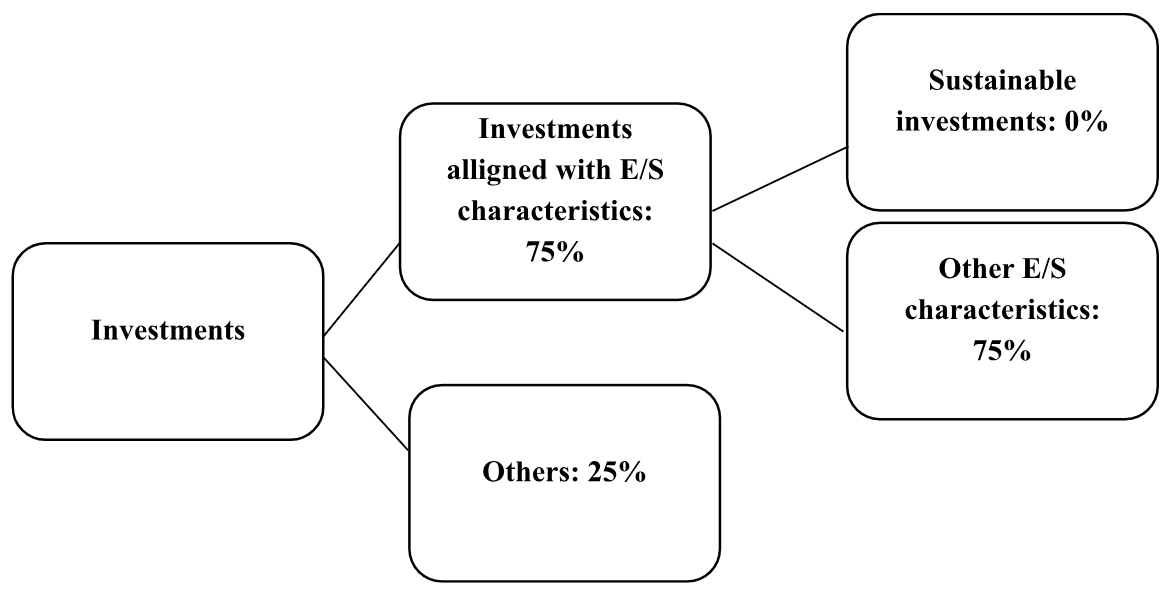
To monitor compliance with environmental and social characteristics, the weighted average ESG rating of FDI BRD Diverso holdings (equities, bonds, exchange traded UCITS in the form of ETFs classified as Article 8 funds according to Regulation (EU) 2019/2088 and exchange traded UCITS in the form of ETFs classified as article 9 funds according to Regulation (EU) 2019/2088, and money market instruments) classified in the portfolio section with improved environmental and social characteristics (minimum 75% of total assets) must not exceed 25. The weighted average score will be subject to continuous monitoring, while the ESG scores of the financial instruments held in the portfolio will be updated on a semiannual basis., and if it rises above 25, the fund portfolio will be rebalanced within a reasonable timeframe and respecting investors’ interests.
The fund will not be exposed to financial instruments with an ESG score above 50 according to Sustainalytics. . ESG scores of financial instruments are verified before investment and periodically during holding.
There may be situations in which the Administrator is unable to immediately dispose of financial instruments that become ineligible under the investment strategy used to select investments meeting each of the environmental or social characteristics promoted (for example, due to the low liquidity of the financial instrument or other factors beyond its control). In such cases, the Administrator acts with due diligence and seeks to divest the investment as soon as possible, while at all times ensuring the protection of investors’ interests.
Measurement of how the social and environmental characteristics promoted by FDI BRD Diverso are met is based on ESG scores provided by a third-party provider, Morningstar, which provides Sustainalytics ESG ratings. Sustainalytics’ ESG risk ratings measure a company’s exposure to industry-specific intrinsic ESG risks and how well the company manages these risks. This multi-dimensional ESG risk measurement combines management and exposure concepts to provide an absolute ESG risk assessment. Sustainalytics identifies five categories of ESG risk severity that may affect a company's rating.
| Negligible | Low | Medium | High | Severe |
| 0-10 | 10-20 | 20-30 | 30-40 | 40+ |
ESG Risk Rating Scale:
Sustainalytics’ ESG risk rating methodology1 includes:
- Total exposure: Initially determines exposure to each material ESG sector.
- Manageable risk: Analyzes what part of company risk can be effectively managed through ESG programs and policies.
- Unmanageable risk: Some risks are considered unmanageable. For example, an oil company cannot fully eliminate carbon emissions risks, so these are excluded.
- Managed risk: For manageable risk, company’s performance is reflected in its policies, programs, practices, and quantitative performance measures.
- Management gap: Reflects unmanaged risk. Controversies reduce management score as they show deficiencies in company programs and policies.
- Unmanaged risk: Overall ESG risk is calculated by adding unmanaged risk values for each significant ESG aspect.
1 Details regarding the methodology used by Sustainalytics can be found here: https://www.sustainalytics.com/esg-data
FDI BRD Diverso uses ESG scores from a third-party provider (Morningstar, providing Sustainalytics ratings) to build a portfolio with improved ESG characteristics. The Sustainalytics methodology is described above. The assessment of good governance practices of investee companies combines external ESG data sources (such as ESG ratings from Sustainalytics and data provided by Bloomberg) with proprietary qualitative assessments for issuers that do not have sufficient external evaluations (based on Société Générale’s sectoral policies as well as on company disclosures). In such cases, particular attention is paid to remuneration policies, labor relations, and tax compliance—areas considered relevant to the issuer’s long-term stability.Data quality is ensured by using reputable sources (ESG scores calculated by Sustainalytics are taken from Morningstar or the Bucharest Stock Exchange). ESG scores provided by Morningstar, Bloomberg governance data, Societe Generale sector policies, and company reports are periodically verified for updates and monitoring.
ESG evaluations used for monitoring ESG characteristics and risks of the fund are obtained via a platform provided by Morningstar or the BVB. Based on Sustainalytics ESG ratings, the weighted average ESG score of financial instruments with improved environmental and social characteristics (equities, bonds, exchange traded UCITS in the form of ETFs classified as Article 8 funds according to Regulation (EU) 2019/2088 and exchange traded UCITS in the form of ETFs classified as article 9 funds according to Regulation (EU) 2019/2088, and money market instruments) representing at least 75% of total fund assets is calculated. The effective exposure of these instruments in the portfolio is rescaled to 100%. The weighted average score is calculated as the weighted arithmetic mean of the holdings' scores in the portfolio section with improved environmental and social characteristics. The management company does not estimate ESG ratings.
Since ESG is a relatively new field, ESG analysis inherently presents challenges: company-level data may be incomplete, unstandardized, inaccurate, or temporarily unavailable; different rating providers use different methodologies, leading to varying ESG risk assessments.
ESG scores are updated periodically but may lag in reflecting risks due to complexity.
These limitations are inherent to the ESG domain due to the complexity of covered risks and the relatively recent integration of ESG in investment processes. FDI BRD Diverso promotes environmental and social characteristics generally, intending to contribute to reducing sustainability risks nationally. Given the fund’s diversification and use of a reputable ESG rating provider covering a wide range of ESG aspects with periodic updates, these limitations should not significantly affect the fund’s ability to meet environmental and social characteristics.
BRD Asset Management S.A.I. S.A. has implemented internal governance controls to ensure obligations are met. Holdings classified in the portfolio section with improved environmental and social characteristics (minimum 75% of total assets) are periodically reviewed to limit the fund’s ESG risks by verifying: (i) ESG scores of financial instruments with improved environmental and social characteristics (equities, bonds, exchange traded UCITS in the form of ETFs classified as Article 8 funds according to Regulation (EU) 2019/2088 and exchange traded UCITS in the form of ETFs classified as article 9 funds according to Regulation (EU) 2019/2088, and money market instruments) do not exceed 50 according to Sustainalytics; otherwise, the non-compliant instrument will be divested within a reasonable timeframe respecting investors’ interests;; (ii) aggregate average ESG score of instruments with improved environmental and social characteristics (equities, bonds, exchange traded UCITS in the form of ETFs classified as Article 8 funds according to Regulation (EU) 2019/2088 and exchange traded UCITS in the form of ETFs classified as article 9 funds according to Regulation (EU) 2019/2088, and money market instruments) does not exceed 25; otherwise, the fund portfolio will be rebalanced within a reasonable timeframe respecting investors’ interests. The company includes procedures dedicated to assessing relevant financial and sustainability risks in its processes.
For FDI BRD Diverso, engagement is not part of the environmental or social investment strategy. However, the fund will support initiatives that contribute to improving environmental, social, or governance characteristics of issuers in which it invests. The fund will vote against initiatives that could increase environmental, social, or governance risks of issuers and against initiatives contradicting internationally recognized ESG principles (e.g., United Nations Global Compact).
FDI BRD Diverso does not have a specific index designated as a reference benchmark to determine whether the financial product is aligned with environmental and/or social characteristics.
Information on how the fund promotes environmental or social characteristics is included in the Annex of the FDI BRD Diverso Issuance Prospectus.
Information on how environmental or social characteristics have been met and on the overall sustainability impact of FDI BRD Diverso can be found in the fund’s annual report.
Mai mult

BRD Acțiuni
Open end Fund investing primarily in stocks but also in monetary instruments. Is seeking for relative high financial…
BRD Diverso
Investment fund of diversified (mixed) type. It invests in several categories of financial instruments (equities, monetary and fixed…
 Monthly comment
 Frequently asked questions
 Contact